Battery Tester Selection Matrix for Cell Grading
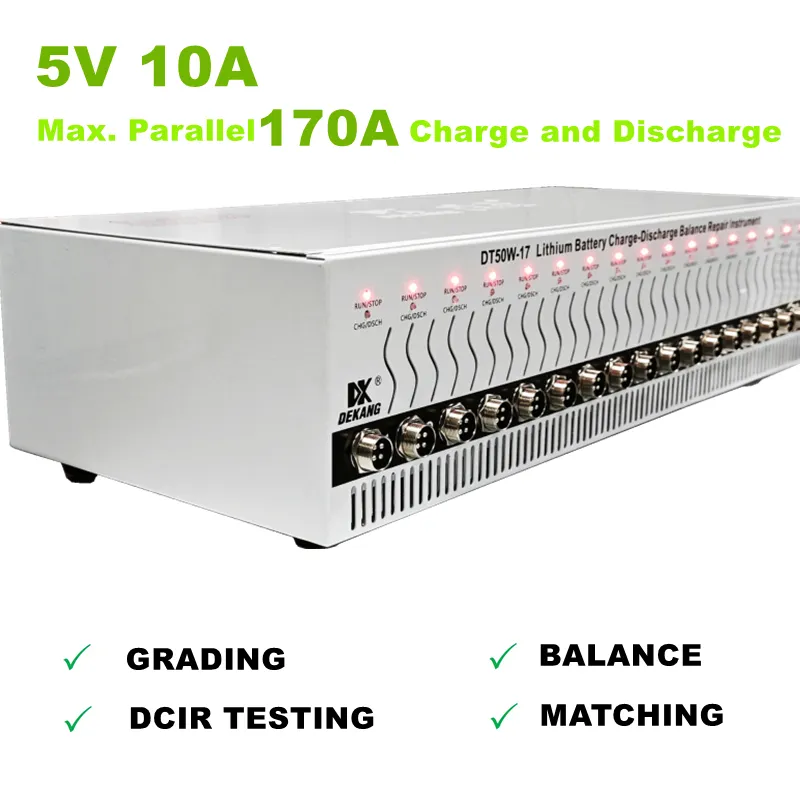
A grading line fails on the wrong channel count long before it fails on price. Start with the DT50W-17, a 17-channel unit running 1–5 V and 0.5–10 A per channel with 100 W of output power on each channel: used as a lithium battery tester it sorts cells into capacity bands, and configured as a lithium ion battery tester it matches cells for pack assembly and rebalances individual cells without disassembly. Work down this page to match cell format, current and simultaneous channel count to the machine you order.
What Counts as a Lithium Battery Tester on This Page
Three jobs define the equipment category covered here. If your requirement sits outside these three, this page is not the right starting point — and the note at the bottom explains why.
Capacity grading
Discharge each cell under controlled current or power, then sort it into a capacity band. On the DT50W-17 the process records voltage, current and capacity on three Y-axes against a shared time axis, and every channel runs its own processor for timing and current control.
Buyer decision: choose grading when cell-to-cell capacity spread is the reason packs fail consistency checks.
Capacity matching
Matching takes the measured results and groups cells that belong together. The matching function automatically identifies which channels meet or miss the matching standard and signals the result by indicator light, so an operator never has to read a spreadsheet mid-shift.
Buyer decision: choose matching when you build series strings and a single weak cell would drag the whole string.
Balance maintenance and internal resistance
Because channels are isolated and directly testable, individual cells inside an assembled pack can be charged, discharged and checked for internal resistance without taking the pack apart. Battery anti-reverse connection protection and alarm run alongside the test.
Buyer decision: choose this job when service, repair or recycling teams need to identify one faulty cell instead of scrapping a pack.
Outside this page's scope: full laboratory cyclers used for multi-day protocol development, end-of-line pack test benches built for complete pack acceptance runs, and BMS validation rigs. Those are different equipment classes with different current, voltage and safety requirements, and they are not covered by the specifications below.
Master Specification Table: DT50W-17
These are the figures to compare against your cell datasheet. Read the voltage window, current window and isolation rating first — they eliminate more machines than any other row.
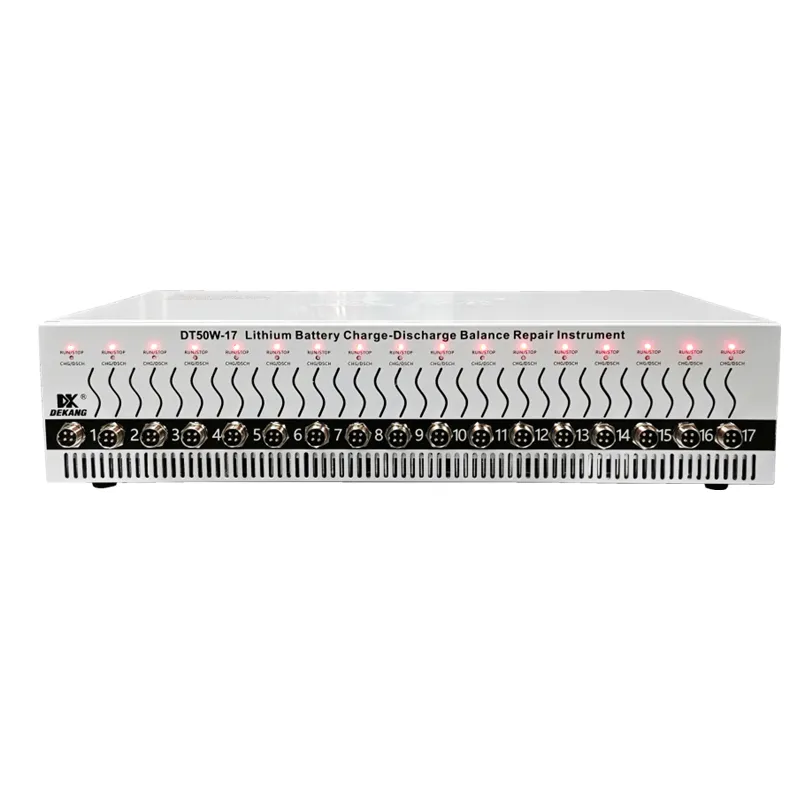
Channel bank and independent control hardware on the DT50W-17 grading and balance maintenance tester.
- Voltage window1 V minimum discharge cut-off to 5 V maximum charge constant voltage, with 0.02 V tolerance. Cells whose datasheet sits outside this window cannot be graded here.
- Current window0.5 A to 10 A on both charge and discharge, 0.02 A tolerance. A discharge that must finish faster than 10 A allows needs a different channel class.
- Isolation ratingAC 1000 V for 2 minutes between channels. This is the row that lets the unit touch individual cells inside a live pack.
| Parameter | DT50W-17 |
|---|---|
| Description | Lithium battery grading and balance maintenance tester |
| Channel number | 17 channels, independently controlled |
| Batteries tested at one time | 17 |
| Input voltage | AC 220 V ±10%, 50/60 Hz |
| Voltage per channel | 1 V min discharge cut-off to 5 V max charge constant voltage; tolerance 0.02 V |
| Current per channel | 0.5 A to 10 A charge and discharge; min charge cut-off current 0.05 A; tolerance 0.02 A |
| Max output power per channel | 100 W |
| Isolation between channels | AC 1000 V / 2 min |
| Sampling connection | Five-core wire connection / probe |
| Communication port | LAN, based on TCP/IP protocol |
| Test report output | Excel |
| Host computer requirement | Windows XP or above with LAN port; server disk configuration over 100 GB |
| Noise | Below 76 dB |
| IP grade | IP20 |
| Applicable chemistries | Li-ion, polymer, Ni-MH, Ni-Cd |
| Work steps | Constant current discharge, constant power discharge, constant resistance discharge, constant current charge, constant voltage charge, constant current and voltage charge, internal resistance test, idle — with automatic step switching |
| Modular scalability | Modular design supports parallel testing with a maximum current capacity of 170 A |
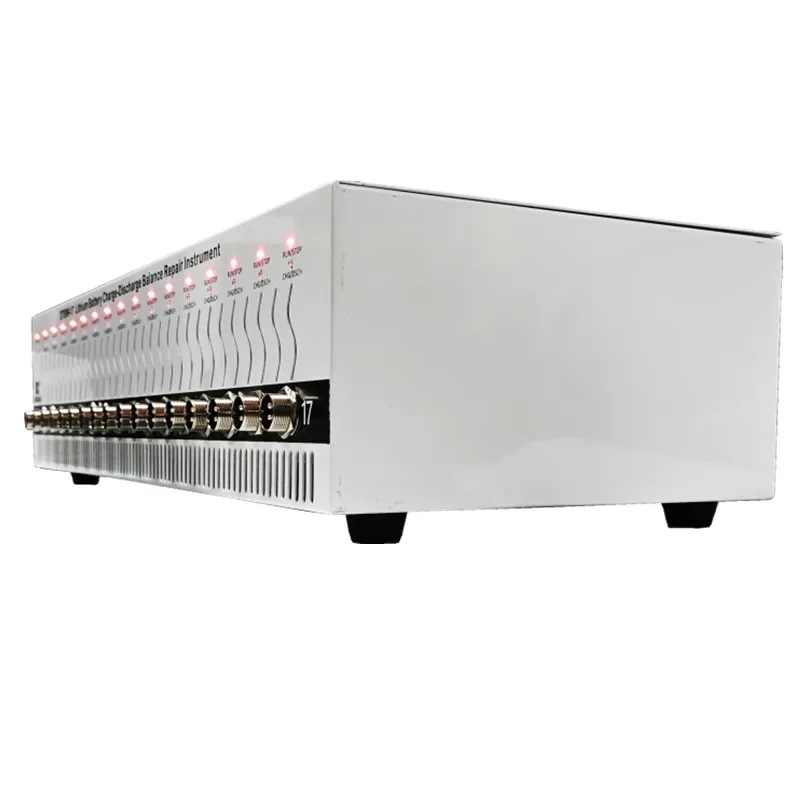
Adjustable probe height with a ruler scale for repeatable seating across cell sizes.
Cell Format and Fixture Compatibility
Physical fit is the first thing operators discover and the last thing buyers check. The DT50W-17 is stated as fully compatible with 18650, 26650, 36650, pouch and prismatic batteries, and the description also lists 32650 cylindrical cells.
The probe height is adjustable and the fixture carries a ruler scale, so an operator can set the same seating height for every cell in a batch instead of eyeballing contact depth. Samples are taken through a five-core wire connection or probe.
Buyer decision: if you grade mixed incoming batches, budget time for a fixture changeover between cylindrical and pouch seating, and standardise the probe height per batch so contact resistance does not drift into your capacity readings.
Sizing Math: From Cells Per Day to Channel Count
Channel count is the only specification a buyer can get badly wrong without noticing. The maths is short, and it runs in three steps.
Divide the cells you must process in a day by the hours available.
Measure how long one full charge and discharge cycle takes for your cell, plus handling between cycles.
Multiply the cells-per-hour figure by the cycle time in hours to get the minimum simultaneous channel count.
Channels needed = (cells per day ÷ operating hours) × cycle time in hours
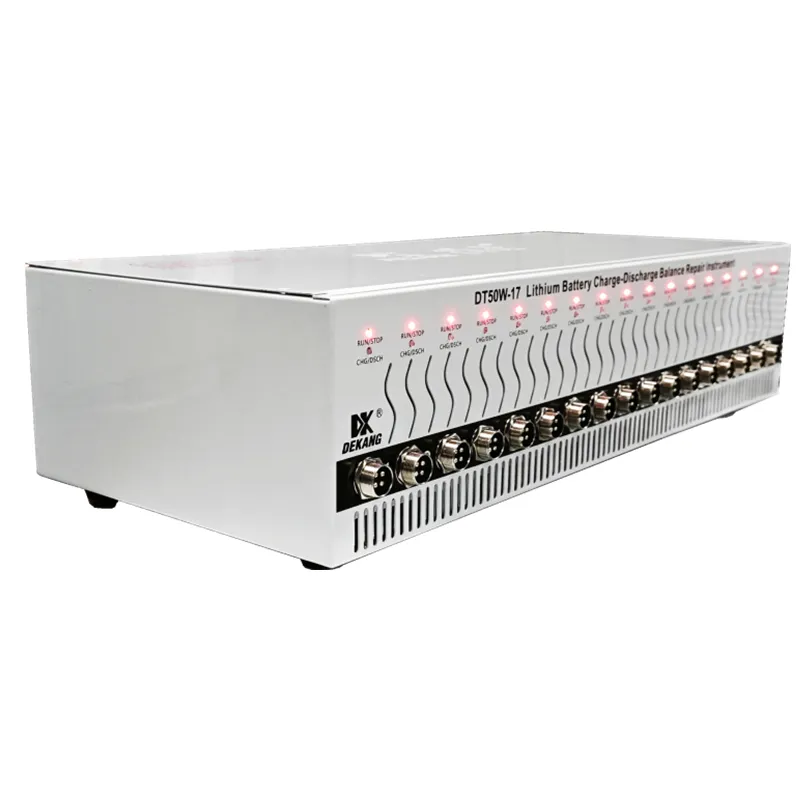
Modular channel design allows identical units to run in parallel and in network groups.
A worked example: 400 cells a day across an 8-hour shift is 50 cells an hour. With a 2-hour cycle, that is 100 channels of simultaneous capacity — well beyond a single 17-channel unit, so the line is built by grouping identical machines rather than buying one oversized cabinet.
Three scaling mechanisms are available on this platform. A single DT50W-17 covers 17 cells at one time. The modular design allows parallel testing with a maximum current capacity of 170 A when units are combined. And the DT50W-136 testing cabinet groups eight single machines at 136 channels, with multiple cabinets connected through a network switch to form a testing machine group.
Buyer decision: if your calculated channel count is not an exact multiple of 17, buy the closest count above your requirement and keep one channel free for re-test and verification batches instead of running every channel flat out.
Data, Matching Logic and Online Operation
The instrument is only as useful as the record it leaves behind. Every channel reports through a LAN connection using the TCP/IP protocol, and results export to Excel for grading records and pack traceability.
- Three-axis curve drawingVoltage, current and capacity are plotted on three Y-axes against a shared time axis, with a data report function for each run.
- Automatic matching flagsThe matching function identifies channels that meet or miss the matching standard and indicates them by flashing indicator light — no manual comparison step.
- Running-status indicationThe LED indicator reports running, testing, matching and alarm states at the machine, so a shift supervisor can read line status at a glance.
- Process recordingThe test process is recorded, and data recording can be triggered by time interval, voltage interval or current interval.
- Customisable test parametersCharge and discharge parameters can be customised, and the colour of the test status bar can be set to match your internal test categories.
- Online PC testComputer and device run online together, with settings and results kept particular and plentiful for later comparison.
Read this before you specify a matching standard: matching only means something if the grading step used the same current, cut-off voltage and recording interval. Fix those parameters first, then let the machine flag the channels.
Scenario to Specification: Which Configuration Fits
Five common buying situations, the specification row that decides each one, and the equipment shape that answers it.
| Scenario | Deciding specification | Equipment shape |
|---|---|---|
| Laboratory validating small sample batches | 1–5 V window and 100 W per channel are ample; per-channel recording matters more than channel count | One DT50W-17 with time-interval or voltage-interval recording enabled |
| Pack assembly line matching cells for series strings | Automatic matching flag plus internal resistance test, run after capacity grading on the same channels | DT50W-17 with matching mode active, scaled out with identical units as volume grows |
| Recycling or incoming inspection of mixed cells | Format compatibility across 18650, 26650, 36650, pouch and prismatic, with repeatable probe height | DT50W-17 using the adjustable probe and ruler scale per batch |
| Service centre diagnosing a built battery pack | AC 1000 V / 2 min channel isolation and anti-reverse connection protection | DT50W-17 testing individual cells inside the pack without disassembly |
| High-throughput line above 17 cells at a time | Simultaneous channel count and modular parallel capability up to 170 A | Grouped units or a multi-cabinet testing machine group connected through a network switch |
Send Your Cell Format, Current and Channel Target for Configuration
Share the cell format, the maximum current per channel you need, and your daily cell volume. Charge and discharge parameters can be customised for your workflow, and larger orders and scale-out groupings are configured before shipment. Send the requirement and get the channel count, wiring and reporting setup matched to your line.
Related Products
Keep adjacent product options together for a faster catalog comparison.
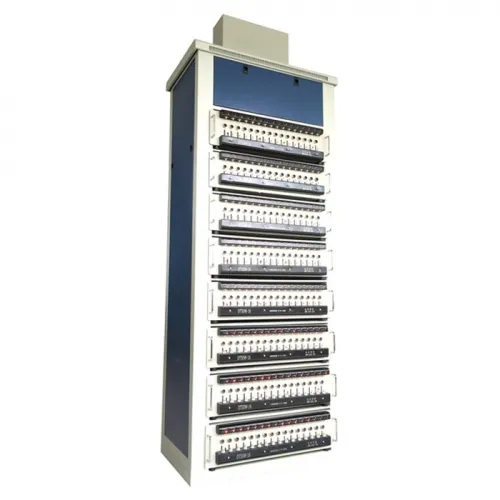
Lithium Cell Capacity Grading And Matching Charge Discharge System DT50W-128
The Li-ion Cell Capacity Grading and Matching Charge Discharge Tester 113 is designed for accurate capacity testing and cell matching.
View product
20-Channel 5V 10A Lithium Cell Charge Discharge Testing and Balance
The 5V 10A Li-ion Tester DT50W-20 provides precise and fast testing for lithium-ion cells, making it the perfect solution for battery test equipment manufacturers and battery testers.
View product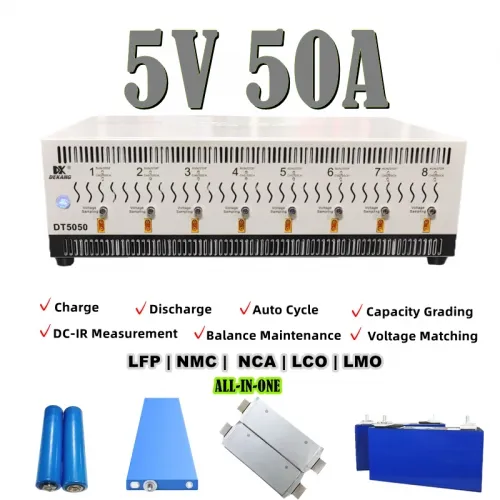
High-Precision Li-Ion Cell Charge Discharge Tester 5V 50A
The Li-Ion Cell Charge Discharge Tester 5V 50A is a powerful and reliable testing solution for lithium-ion batteries.
View productFrequently Asked Questions
how many cells can the dt50w-17 test at the same time?
17. the unit has 17 independently controlled channels and is listed as testing a maximum of 17 batteries at one time, with each channel carrying its own processor for capacity calculation, timing, voltage and current control.
what voltage and current range does each channel support?
each channel runs from a 1 v minimum discharge cut-off to a 5 v maximum charge constant voltage, with 0.02 v tolerance, and from 0.5 a to 10 a on both charge and discharge with 0.02 a tolerance. maximum output power per channel is 100 w, and the minimum charge cut-off current is 0.05 a.
which cell formats and chemistries fit the fixture?
the tester is stated as fully compatible with li-ion, polymer, ni-mh and ni-cd batteries, and with 18650, 26650, 36650, pouch and prismatic cells, with 32650 cylindrical cells also listed in the product description. probe height is adjustable and the fixture includes a ruler scale for consistent seating.
can it test cells while they are still inside a battery pack?
yes. all channels are under isolated test with an ac 1000 v / 2 min insulation rating between channels, which allows direct testing of the cells of a battery pack and balance charge and discharge of individual cells to identify faulty cells without disassembly. battery anti-reverse connection protection and alarm are included.
how do i convert daily throughput into a channel count?
divide cells per day by your operating hours, then multiply by the cycle time in hours. for example, 400 cells across an 8-hour shift is 50 cells an hour; with a 2-hour cycle you need about 100 simultaneous channels. if your figure is not a multiple of 17, the dt50w-136 testing cabinet groups eight single machines at 136 channels, and multiple cabinets can be connected through a network switch to form a testing machine group.
how are results exported and how does matching show on screen?
results are collected over a lan connection using the tcp/ip protocol and export to an excel report, with voltage, current and capacity plotted on three y-axes against a time axis. the matching function automatically identifies channels that meet or miss the matching standard and indicates them by flashing indicator light, while the led indicator shows running, testing, matching and alarm status.